
STAMPED: Seven Questions That Prevent the Wrong Hydraulic Hose From Being Built
Posted by Randy Hydrick on Nov 20th 2026
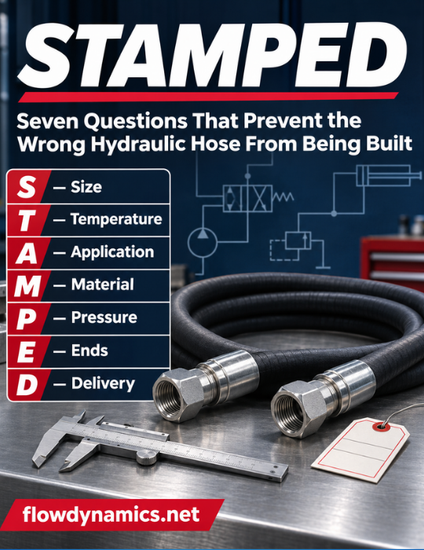
A hydraulic hose can look right, connect correctly and still be wrong for the application.
Matching an old assembly by appearance alone may overlook pressure spikes, temperature exposure, fluid compatibility, routing or fitting orientation. Those details can determine whether the replacement provides reliable service or fails prematurely.
The STAMPED method gives technicians and maintenance teams seven questions to answer before a hydraulic hose is built.
S — What Size Is Required?
Start with the hose’s inside diameter, outside diameter and overall length.
Inside diameter affects fluid velocity and pressure drop. A hose that is too small can restrict flow, generate heat and reduce system performance. A hose that is unnecessarily large may be difficult to route and more expensive without improving operation.
Length also matters. An assembly that is too short may be stretched as equipment moves. One that is too long can sag, rub, kink or interfere with surrounding components.
Before ordering, confirm:
- Hose inside diameter
- Required overall assembly length
- Available routing space
- Minimum bend radius
- Whether the hose must accommodate movement
Do not assume the old hose was correctly sized—especially if it failed repeatedly.
T — What Temperatures Will the Hose Experience?
Consider both the temperature of the hydraulic fluid and the environment around the hose.
A hose routed near an engine, exhaust system, furnace or other heat source may experience temperatures well above the fluid temperature. Cold-weather startup conditions can also affect flexibility and performance.
Confirm:
- Normal and maximum fluid temperature
- Ambient operating temperature
- Exposure to radiant heat
- Proximity to exhaust or other hot surfaces
- Cold-weather operating conditions
Heat shields, fire sleeves and protective covers may be needed, but they do not make an incorrectly rated hose suitable for the application.
A — What Is the Application?
Understanding what the hose does is just as important as knowing where it connects.
A stationary return line has different requirements than a hose serving a boom, steering circuit, hydraulic attachment or high-cycle cylinder. The assembly may be exposed to movement, vibration, impulse cycles, twisting or external loads.
Ask:
- Is the equipment mobile or stationary?
- Does the hose flex during operation?
- Is the circuit subject to frequent pressure cycling?
- Will the hose rub against another hose or machine surface?
- Is suction or vacuum performance required?
- Could the assembly be pulled, twisted or crushed?
The application determines the hose construction and reinforcement needed—not simply the connection size.
M — What Material or Media Will Flow Through It?
The inner tube must be compatible with the fluid being conveyed. The outer cover must also withstand the surrounding environment.
Hydraulic oils are not all the same. Some systems use synthetic fluids, biodegradable oils, water-glycol solutions, phosphate esters or other specialized media. A hose suitable for conventional petroleum-based hydraulic oil may not be appropriate for every fluid.
Confirm:
- Exact hydraulic fluid or media
- Fluid concentration, when applicable
- Cleaning agents that may contact the hose
- Exposure to oil, chemicals, saltwater or ultraviolet light
- Cover requirements for abrasion, ozone or weather resistance
Compatibility should extend to the hose tube, reinforcement, cover, seals and fittings.
P — What Pressure Must the Assembly Handle?
Use the system’s maximum operating pressure—not an average reading or what the operator believes the machine normally reaches.
The assembly must also account for pressure spikes and impulse cycles that may not appear on a standard gauge. Troubleshooting data from a pressure transducer or recording gauge may reveal conditions that contributed to the previous failure.
Determine:
- Normal operating pressure
- Maximum system pressure
- Relief-valve setting
- Potential pressure spikes
- Frequency of pressure cycling
- Whether the circuit can experience vacuum
Every component in the assembly must be rated appropriately. The working pressure of the complete assembly is limited by its lowest-rated component.
E — What Ends Are Required?
Hydraulic fittings that appear similar are not necessarily interchangeable.
Thread type, sealing method, seat angle, flange style and fitting orientation must be identified correctly. For angled fittings, the relationship between each end—sometimes called the clocking—can determine whether the assembly installs without being twisted.
Verify:
- Thread or flange type
- Size and sealing method
- Straight, 45-degree or 90-degree configuration
- Fitting orientation
- Male or female connection
- Material and corrosion-resistance requirements
Avoid forcing a connection or substituting an adapter simply because the fitting does not match. The wrong connection can leak, damage the mating component or create an unnecessary restriction.
D — What Delivery Requirements Apply?
Delivery involves more than when the hose is needed.
A replacement may require specific testing, cleaning, labeling, protective caps or documentation before it enters service. Critical assemblies may also need to be stocked or duplicated to reduce future downtime.
Ask:
- When is the assembly needed?
- Is this an emergency replacement or planned maintenance?
- Does the customer need one assembly or several?
- Are pressure testing or certification required?
- Are cleanliness, flushing or capping requirements specified?
- Should the assembly be labeled for future identification?
- Should a spare be built and stored?
Recording the final specifications makes the next replacement faster and reduces the likelihood of repeating the same identification process.
Bring More Than the Old Hose
The failed hose is useful, but it does not tell the entire story. When possible, also provide:
- Equipment make and model
- Circuit function
- Fluid type
- Operating pressure and temperature
- Photos of the routing and connection points
- Information about movement or recurring failures
If a hose continues failing in the same location, simply duplicating it may duplicate the problem. Routing, abrasion, heat, pressure spikes or component selection may need to be corrected first.
The STAMPED method helps ensure that a hydraulic hose is built for the actual application—not merely copied from what came off the machine.
Flow Dynamics & Automation can help identify the correct hose, fittings and protective options for demanding hydraulic applications. Bring us the assembly and the operating details so we can help you get the replacement right the first time.